

AI-Powered Test Automation: E2E Testing and Quality Assurance Integrated with CI/CD
Enhance software quality! Explore AI-driven test scenarios, E2E automation, and continuous quality control methods integrated with CI/CD processes.
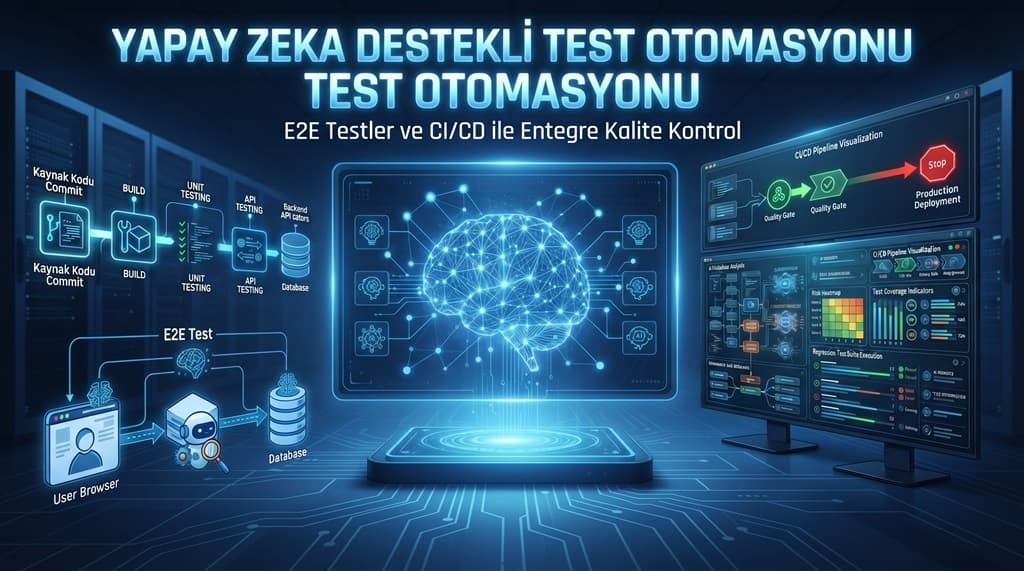
Quality is just as important as speed in software projects. The continuous development of applications, the release of new features at short intervals, and the increasing complexity of systems have created a development environment where traditional manual testing methods are no longer sufficient on their own. At this point, AI-driven test scenarios, end-to-end (E2E) test automation, and quality control mechanisms integrated into CI/CD processes are becoming essential components of modern software development life cycles.
With the integration of artificial intelligence technologies into software testing processes, many operations—from test scenario generation to error analysis, and from regression testing to automated reporting—can be executed much more efficiently. Meanwhile, integration with CI/CD systems ensures that quality control transitions from being a separate step at the end of the development phase to becoming a continuously running part of the software life cycle.
What Are AI-Driven Test Scenarios?
Test scenarios consist of steps that define how an application should behave under specific conditions. In the traditional approach, these scenarios are mostly prepared manually by software developers or QA teams.
In the AI-driven test scenario generation approach, the creation and evolution of test scenarios can be supported by analyzing requirements, user stories, acceptance criteria, API definitions, or existing application behaviors.
For example, consider the checkout process in an e-commerce application. A user logging into the system, searching for a product, adding it to the cart, entering address details, and completing the payment involves many different test steps.
Artificial intelligence can help identify not only the successful path but also alternative scenarios such as invalid inputs, missing fields, unauthorized operations, unexpected user behaviors, and edge cases. This approach contributes to expanding test coverage, especially in large projects, and catching overlooked scenarios earlier.
![[object Object]](/media/yapay-zeka-destekli-test-senaryolari-300x300.png)
Why Is E2E Test Automation Important?
End-to-End (E2E) testing is a testing approach that verifies the functioning of a system from start to finish from the user's perspective. The goal here is not merely to check whether a single function works correctly; rather, it tests whether a real operation performed by the user is completed seamlessly across different layers of the application.
For instance, when a user logs into the system by entering their email and password on the login screen, the process is not limited to the user interface. An API request is generated by the frontend, the backend performs authentication, the database can be queried, and the relevant screen opens after assigning the necessary permissions to the user.
An E2E automation system can test this entire chain in a manner closely resembling real user behavior. Tools like Playwright, Cypress, and Selenium can be used for this purpose in web applications. Thanks to test automation, critical user flows can be re-executed after every new development. Thus, it can be detected much faster whether a newly developed feature has broken a previously functioning feature—in other words, whether it has introduced a regression.
Combining AI with E2E Testing
The combined use of artificial intelligence and E2E automation can make testing processes not only automated but also more dynamic. In classical automation systems, test scenarios are predefined, and the system repeats these steps. In AI-driven structures, missing scenarios can be suggested by analyzing requirements and existing tests.
For example, when a new user role is added to the system, artificial intelligence can analyze the existing authorization structure and help prepare test scenarios regarding which screens different user roles should be able to access. Similarly, the adequacy of current test coverage can be evaluated by examining API changes, new user interface features, or modified business rules. This structure helps QA teams direct their attention to more critical and complex scenarios instead of manually reviewing hundreds of test cases continuously.
![[object Object]](/media/uctan-uca-e2e-test-otomasyonu-300x300.png)
Quality Control Integrated into CI/CD Processes
In modern software development teams, testing code should not be a phase executed solely after development is complete. Quality control mechanisms need to be integrated into the entire development process. CI/CD integration plays a crucial role here.
Continuous Integration (CI) ensures that changes made by developers are regularly merged with the main code base and subjected to automated checks. Continuous Delivery or Continuous Deployment (CD) automates the release of validated software versions to test, staging, or production environments. When test automation is included within the CI/CD pipeline, designated tests can be run automatically after every code change.
A typical process can proceed as follows: Code change is made → build process is initiated → static code analyses are performed → unit tests are run → API/integration tests are executed → critical E2E scenarios are run → results are analyzed → if required quality criteria are met, the deployment phase is reached.
This mechanism helps reduce the probability of a faulty change directly reaching the production environment.
How Does the Quality Gate Mechanism Work?
One of the most critical quality control points in a CI/CD system is the Quality Gate approach. A Quality Gate is a set of rules that software must satisfy before proceeding to the next stage. For example, if one of the critical E2E tests fails, the pipeline can be automatically stopped. Similarly, the detection of critical vulnerabilities above a certain level, a failed build process, or failing important integration tests can block deployment.
Thus, quality control ceases to depend solely on the manual decisions of team members and is applied automatically based on predefined rules. This approach is particularly important in enterprise software projects where numerous developers work on the same project.
![[object Object]](/media/ci-cd-entegre-kalite-kontrol-s%C3%BCreci-300x300.png)
How Can AI Facilitate Error Analysis?
One of the major challenges in test automation is determining the root cause of failed tests. Especially in large projects with hundreds or thousands of automated tests, knowing merely that a "test failed" is insufficient.
Artificial intelligence can be utilized here to analyze test logs, error messages, HTTP responses, and previous test results. For instance, when an E2E test fails, the system can collect screenshots, browser logs, network requests, and application logs. The AI-driven analysis mechanism can then evaluate this information and present a summary to the developer regarding the probable source of the error. This approach can help shorten error resolution time. Additionally, additional context can be provided to developers by examining which changes in the past led to similar errors.
Intelligent Regression Testing
Running the entire test suite after every code change is not always efficient. Large projects can contain thousands of tests, and completing the test suite can take a long time. In the AI-driven intelligent regression testing approach, relationships between code changes and existing test scenarios can be analyzed.
For example, if only the payment module has been modified, the system can assign higher priority to tests related to payment, cart, and order processes. Meanwhile, critical system tests can be ensured to run under all circumstances, creating a risk-based testing strategy. Consequently, both CI/CD pipeline durations can be optimized, and the test coverage of high-risk areas can be protected.
![[object Object]](/media/yapay-zeka-destekli-akilli-regresyon-testleri-300x300.png)
Continuous Quality Control Approach
The primary goal of AI-driven test automation is not to completely eliminate the human factor. The main objective is to automate repetitive checks and empower teams to focus on more complex quality problems. Developers can utilize unit and integration tests while writing code, QA teams can define critical user scenarios, E2E automation systems can continuously validate these flows, and artificial intelligence can simplify the analysis of obtained results. The CI/CD pipeline becomes the collaborative workspace for all these mechanisms.
Ultimately, quality control ceases to be a one-time check performed at the end of the software development process, transforming into a continuous quality control process that persists from code creation all the way to deployment in production.
Conclusion
AI-driven test scenarios, E2E test automation, and CI/CD integration are powerful approaches that can be used together to make quality sustainable in modern software development processes. While artificial intelligence supports the preparation and analysis of test scenarios, E2E automation ensures the continuous verification of real user flows. CI/CD integration turns these checks into a natural part of the software delivery pipeline.
In a properly designed architecture, every code change is automatically checked, critical user flows are tested, data from failed tests is analyzed, and versions failing to meet quality criteria are prevented from progressing to production. Thus, software teams can aim not only to release versions faster but also to build a more reliable, sustainable, and measurable software quality process.
For More Information
To learn more about AI-driven test automation, E2E testing processes, and CI/CD integrated quality control solutions, you can reach us at +90 312 256 72 78 or visitwww.arcayazilim.comfor detailed information and our other solutions.