
Generating Test Scenarios from a Requirements Document
Test scenario generation is now automated with artificial intelligence. Learn how a requirements document becomes a Playwright test.

In this article we explain how test scenario generation has been automated with artificial intelligence. One of the jobs test teams spend most of their time on in a software project is reading the requirements document and converting it, item by item, into test scenarios. For an SRS document running to hundreds of items, this can take weeks. What is more, every time the document is updated the team has to go over the scenarios again.
Yet the source of the test scenarios is already there: the requirements document itself. That is the starting point of AI-supported test automation — generating scenarios straight from the document instead of writing them by hand. Below we look at how this approach works, what it gains you, and what to watch for when applying it.
What Is Test Scenario Generation from a Requirements Document?
In the classic process, the business analyst writes the requirement, the test engineer reads that document and prepares a test scenario by hand for each item. The team then either runs these scenarios manually or converts them into automation code. At every stage there is human effort and room for differing interpretations.
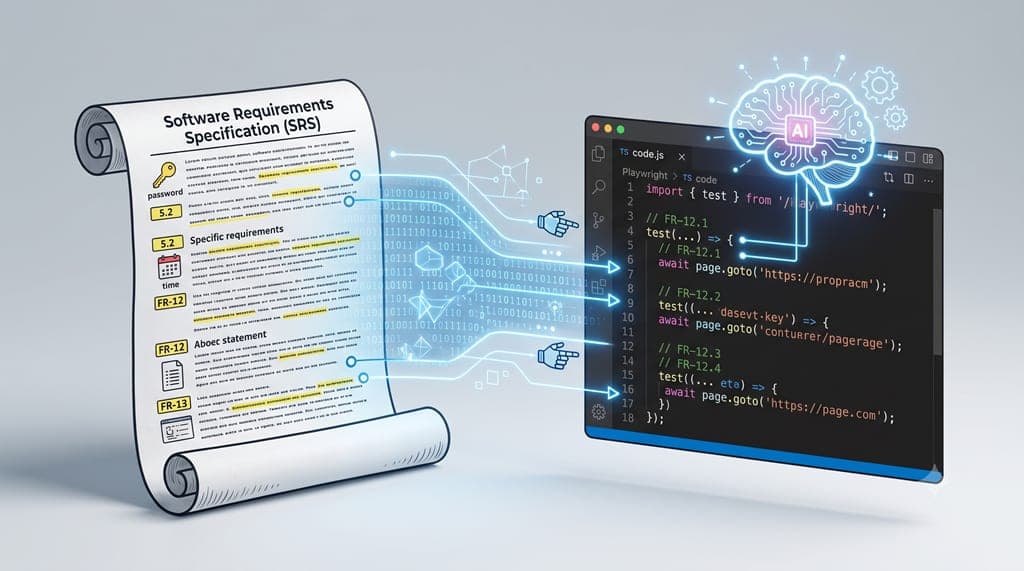
Automatic test scenario generation from a requirements document shortens this chain. Artificial intelligence reads the SRS (Software Requirements Specification) document, extracts the testable items and produces a scenario for each one. Those scenarios then turn into working automation code.
The critical feature of the approach is traceability: the system matches every scenario it generates to the requirement number (FR) it came from. You can therefore report at any moment which item is being tested and which has been left uncovered.
How Does Test Scenario Generation Work, Step by Step?

Tools applying this approach generally work in four steps:
- Document analysis: the system reads the requirements document in Word, PDF or Markdown format and divides it into testable feature groups. Groups such as login, authorisation and reporting are each handled in their own right.
- Scenario extraction: the tool produces scenarios in Given/When/Then format for each requirement item. A good scenario has a single observable expectation, such as "the account is locked when an incorrect password is entered three times".
- Test generation: the system builds E2E tests from the scenarios that run with tools such as Playwright. The test code carries out the scenario's steps on the application's real interface.
- Execution and reporting: the tool runs the tests against the application. It marks each scenario as passed, deviating from the requirement, or not runnable, and reports them with a coverage matrix.
What you end up with is not only test code; the coverage matrix showing how requirements, scenarios and tests map to one another is a natural output of the process too.

What Is Being Seen in Practice?
This approach is not confined to paper. Meta published the results of its LLM-based test generation tool in 2024. In an evaluation on the Instagram and Facebook codebase, a quarter of the generated tests increased code coverage measurably. In review sessions with engineers, 73% of the tool's suggestions were accepted into production (ACM FSE 2024).
The picture is similar on the enterprise side. According to Capgemini's World Quality Report 2024-25, 68% of organisations are using generative artificial intelligence in quality engineering or have it on their road map; 72% of respondents say their test automation processes have sped up as a result.
The Benefits of AI-Supported Test Automation
- Time and cost: scenario writing that can take weeks by hand can come down to hours, even minutes; less engineering time goes into repetitive writing.
- Coverage: items in the document do not slip through. Because the coverage matrix shows the gaps, the team notices something like "no tests were ever written for the reporting module" before release.
- Traceability: in audits and client acceptance, the answer to "which requirement was verified by which test" is ready.
- Maintainability: when a requirement changes, the scenarios are regenerated; your test set follows the document, and your team focuses on analysis and exploratory testing.
Where the Industry Is Heading: AI Support Spreads
Gartner forecasts that by 2027, 80% of organisations will have added AI-supported test tools to their toolchain; at the start of 2023 that figure was around 15%.
The trend is the same among developers. In Stack Overflow's 2025 survey, 84% of respondents said they use AI tools or plan to; 80% expect these tools to become more integrated with code testing.
Points to Watch
AI test automation is not a set-and-forget approach. Three matters deserve particular attention:
- Reliability: artificial intelligence can produce incorrect or incomplete scenarios. In Capgemini's 2025-26 report, 60% of organisations count hallucination and reliability problems among the biggest obstacles. The team should review generated scenarios with a human eye and report execution results transparently.
- Determinism: when the model is updated, test results must not change unnoticed. Well-designed tools pin the model version and compare results against a reference set of known accuracy.
- Data privacy: in the same report, 67% of respondents see data privacy as an obstacle. The requirements documents in your organisation most likely contain confidential information; solutions that run locally, where neither the documents nor the access credentials leave the organisation, reduce this risk.
Frequently Asked Questions
Which document formats are supported? Tools in this field commonly work with Word (.docx), PDF and Markdown documents. The document is first converted to text, then analysed. Is it necessary to share source code? Not necessarily. Some approaches can generate tests without access to the source, by navigating the live application's interface. This method is preferred in projects with high confidentiality requirements. How long does the process take? It varies with document size and the tool used; scenario extraction is mostly completed within hours. Since the same work can take weeks by hand, the real gain shows up in that comparison. What happens if the AI produces a faulty scenario? Because every scenario is tied to a requirement number, faulty generation is spotted quickly; execution results are also marked individually. The final decision always rests with the test engineer. Does the existing test infrastructure need to change? Most tools produce output in standard test frameworks such as Playwright; the tests can be added to your existing CI/CD pipeline.
Conclusion
In most organisations the requirements document is a file read only before development begins. AI-supported test automation turns it into a living source of tests: the system generates scenarios from the document, measures coverage and reflects changes in the test set. At Arca Yazılım we are working on this approach in software testing and quality processes.
To find out more about this subject you can reach us on 0312 256 72 78, and for detailed information and our other solutions you can visit www.arcayazilim.com.