
What Is ETL? What Is ELT? A Guide to Choosing the Right Architecture with Power BI, SQL and a Data Warehouse
The differences between the ETL and ELT approaches, and a comprehensive guide to choosing the right architecture in Power BI, SQL and data warehouse scenarios.
One of the most common mistakes in business intelligence projects is asking the wrong question at the very start. "Should we do ETL or ELT?" is incomplete on its own. The real question is this:
"Which data flow is the most sustainable for our data volume, our source systems, our team's skills, our reporting needs and our security constraints?"
Because the ETL/ELT choice is not merely a technical preference; it directly determines:
- the speed of reports,
- data quality,
- operating cost,
- development speed,
- and the maintenance burden over the long term.
In this guide we clarify ETL and ELT, then give a practical decision framework for the "which one in which scenario" question in the Power BI, SQL and data warehouse world.
What Is ETL?
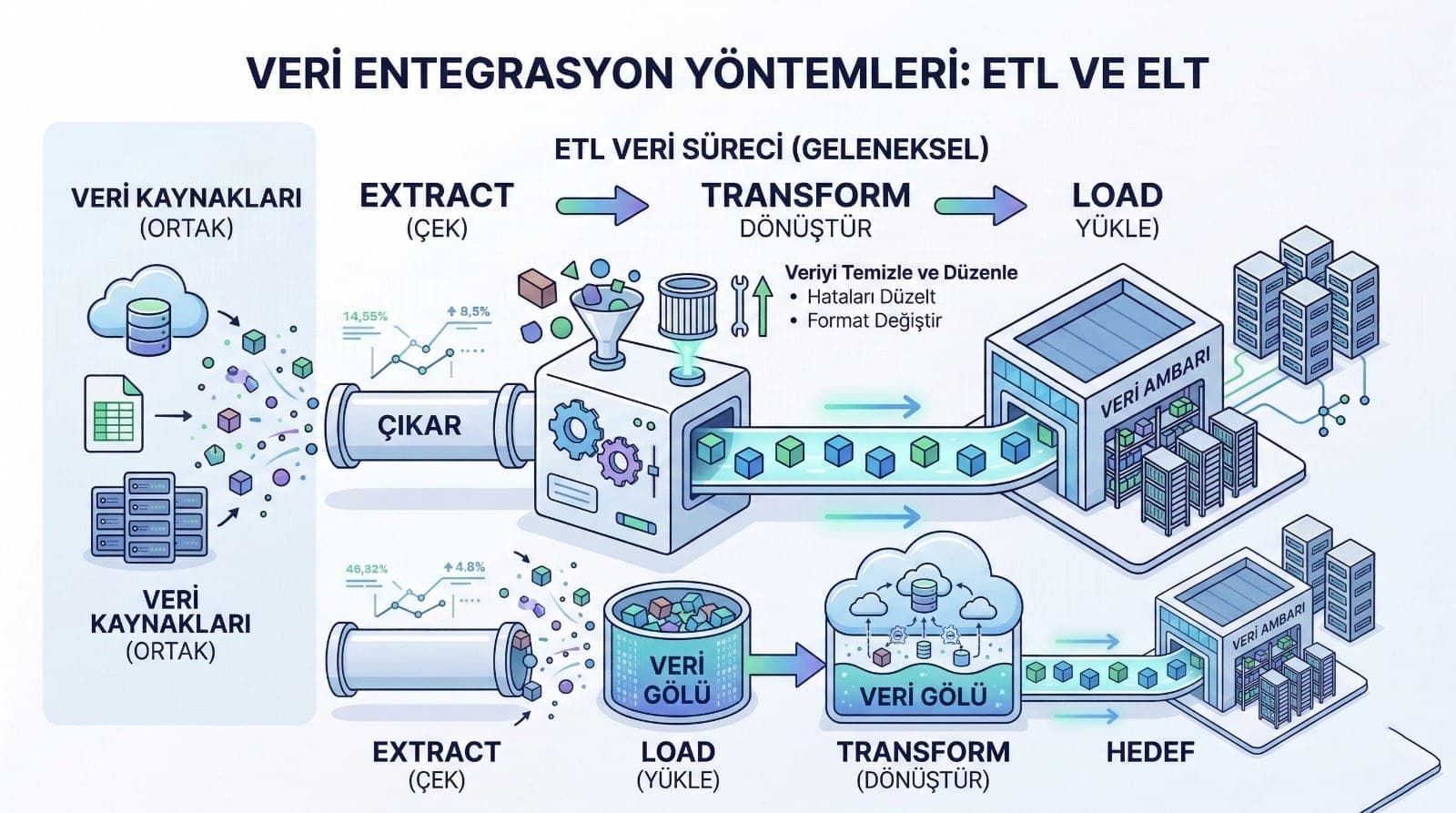
ETL = Extract → Transform → Load
You extract the data from the source, transform it — usually on an ETL tool or service — and then load it into the target system (a data warehouse, for instance).
The core characteristics of ETL
- Transformations happen before loading
- Data arrives at the target warehouse ready, clean and with the rules already applied
- Data quality and control points are gathered in the ETL layer
ETL's "classic" area of use
- Enterprise data warehouse (DWH) structures
- Scenarios such as on-premises SQL Server plus SSIS
- Tightly governed, auditable reporting systems
What Is ELT?
ELT = Extract → Load → Transform
In this approach you first load the data into the target platform (a DWH or lakehouse) in raw or semi-raw form. You then carry out the transformations using the target's own processing power, usually with SQL.
The core characteristics of ELT
- Transformations happen after loading
- The target platform offers strong processing capacity (warehouse/lakehouse)
- Keeping raw data becomes easier (reprocessing, versioning)
ELT's "modern" area of use
- Cloud-based lakehouse/warehouse architectures
- Big data and semi-structured data (JSON, logs and so on)
- Product and analytics teams whose transformation rules change quickly
ETL vs ELT: A Short Comparison
The table below settles the difference at a glance:
In short: ETL is more controlled and classic; ELT is more flexible and modern. But "modern" does not always mean "right".
How Do ETL and ELT Sit in the Microsoft Business Intelligence Ecosystem?
When we say Power BI, SQL and DWH, we see two main architectural worlds in practice:
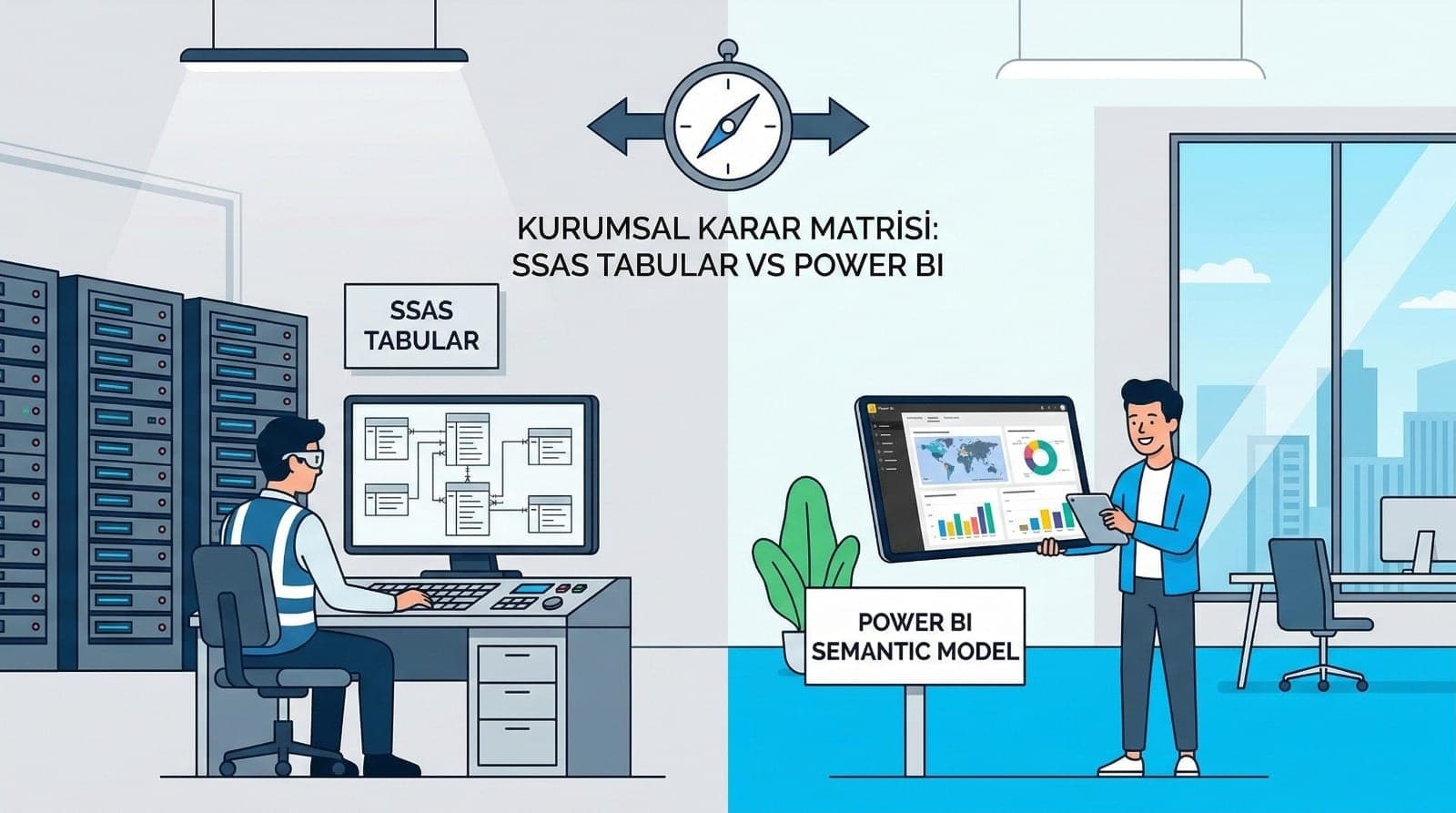
1) A classic SQL Server-based DWH (mostly ETL)
- Sources: ERP/CRM/operational databases
- ETL: SSIS-style flows and scheduled jobs
- Target: a SQL Server data warehouse (dimension-fact)
- Presentation: a Power BI semantic model / dataset
ETL sits naturally in this world: you load clean data into the DWH and the Power BI model is fast.
2) Lakehouse/warehouse-based modern analytics (mostly ELT)
- Sources: databases, APIs, files and logs
- Load first: raw data into a landing/staging area
- Transform after: a gold layer built with SQL-based transformations
- Presentation: Power BI (Import/DirectQuery/Composite) plus a semantic model
In this world ELT is strong on the logic of "keep the raw data, transform as needed".
The Power BI Perspective: How Does the ETL/ELT Choice Affect Report Performance?
Power BI performance generally rests on:
- Modelling (star schema)
- Data volume and granularity
- The refresh strategy
- The Import/DirectQuery choice
The ETL/ELT choice touches all of these directly:
The advantage on the ETL side
- Because the DWH layer is already report-ready, the Power BI model is built faster
- The dimension-fact structure is clear
- Data quality rules are applied first
The advantage on the ELT side
- Starting from raw data and producing models as the need arises is easy
- The burden of "rewriting the ETL" for a new report can be reduced
- Because transformations can be managed in SQL, iteration is fast
The practical truth: on the Power BI side the most critical target is usually a star schema. ETL and ELT can both serve that target. What matters is less where you put the transformations than whether the gold layer feeding Power BI is properly designed.
In Which Scenarios Is ETL the Better Choice?
The following situations favour ETL:
1) When on-premises systems and the source are sensitive
If data has to be moved without straining the source systems, within controlled loading windows, ETL is tidier.
2) When data quality and audit are critical
In areas such as finance, accounting and regulation, where:
- the rules are clear,
- changes are controlled,
- and audit trails are required, the ETL approach is safer.
3) When transformations are very complex and pipeline-oriented
Some transformations — multi-step business rules in particular — can be more manageable within an ETL flow.
4) When the team is strong in "BI/ETL culture"
Teams who know ETL tools well move faster and with less risk using ETL.
In Which Scenarios Is ELT the Better Choice?
Typical situations that favour ELT:
1) When data variety is high (databases, APIs, files, logs)
Collecting raw data first and transforming it as the need arises is more flexible.
2) When transformation rules change often
In product analytics, growth, experimentation and anywhere needing fast iteration, the ELT approach is more agile.
3) When the target platform offers strong processing capacity
Where there is scalable compute on the warehouse/lakehouse side, doing the transformation there makes sense.
4) When keeping raw data is strategic
Where there is a need for retrospective reprocessing, deriving new KPIs, or data science and ML work, keeping the raw data is a considerable advantage.
The Hybrid Approach: What Is Actually Used Most
In the field, most organisations are neither purely ETL nor purely ELT. The most sustainable structure is usually hybrid:
A layered architecture (bronze / silver / gold)
- Bronze (raw/landing): raw data
- Silver (clean/conformed): cleaned, standardised data
- Gold (serving): report-ready dimension-fact tables and summary tables
The beauty of this approach is that:
- Raw data is not lost
- Transformations are managed layer by layer
- The gold layer going into Power BI is designed for performance
A Decision Framework: ETL or ELT? (Settle It with Seven Questions)
Answer the questions below. Whichever side the "yes" answers weigh towards is where the choice leans.
- Is the source system very sensitive, unable to take heavy queries? → If yes, the case for ETL grows.
- Is keeping raw data mandatory or highly valuable? → If yes, the case for ELT grows.
- Do KPIs and business rules change often? → If yes, the case for ELT grows.
- Are regulation, audit and data accuracy critical? → If yes, the case for ETL grows (or, in a hybrid, the silver/gold layers must be very disciplined).
- Where is the team stronger?
- In ETL tools and pipeline discipline? → ETL
- In SQL transformations and the model layer? → ELT
What is the state of data volume and variety?
- Many sources, many formats → ELT/hybrid
- Few sources, a clear schema → ETL
What is the target mode in Power BI?
- If performance through Import is the goal → a solid gold layer is essential (ETL or ELT makes no difference)
- If DirectQuery dominates → source/warehouse optimisation is critical (ELT plus good SQL design comes to the fore)
Example Architecture Scenarios
Scenario A: A classic enterprise DWH (mostly ETL)
The flow:
- Operational databases (ERP/CRM)
- A staging area
- ETL transformations (business rules plus quality checks)
- The DWH (star schema: fact plus dimension)
- Power BI (semantic model plus reports)
When is it ideal? When reports are well defined, management KPIs are stable and strong data governance is wanted.
Scenario B: Lakehouse/modern analytics (mostly ELT)
The flow:
- Sources (databases, APIs, files, logs)
- Raw/landing (untransformed)
- SQL transformations on the warehouse/lakehouse
- The gold layer (dimension-fact plus summaries)
- Power BI (import/composite)
When is it ideal? When there are many sources, new needs keep arriving and fast iteration is essential.
Scenario C: Hybrid (the most realistic approach in the field)
The flow:
- Raw data is kept in landing (EL)
- Basic cleaning and standardisation is done (silver)
- A star schema plus aggregation tables are produced for reporting (gold)
- Power BI is fed from the gold layer
When is it ideal? When you want both auditability and flexibility. Most organisations wanting both end up here.
The Most Common Mistakes (They Blow Up a Project's Cost)
- "Let's connect the raw data straight to Power BI" (the model then bloats and performance drops)
- Writing a separate transformation rule for every report (one-off KPIs multiply and inconsistency grows)
- Carrying the operational schema into reporting instead of a star schema
- Not establishing an incremental loading strategy (refresh times lengthen)
- Proceeding without writing a data dictionary and KPI definitions (the same KPI gets calculated differently)
A Practical Checklist to Start With
Following these steps at the outset speeds most projects up:
- Clarify the gold layer target: what will Power BI consume?
- Draw a draft of the dimension-fact model (star schema)
- Establish whether raw data needs keeping (is a raw layer required?)
- Plan the incremental loading strategy from the start
- Prepare a KPI dictionary (definition, filters, date logic)
- Decide the Power BI mode (Import/DirectQuery/Composite)
Conclusion: The Right Choice Is Not "ETL or ELT" but "What Should Be Done in Which Layer?"
ETL and ELT are not enemies; set up properly, they are two approaches that complement one another. In the Power BI, SQL and data warehouse world, sustainable success generally comes from:
- Raw data management (where needed)
- Layered transformation discipline (silver/gold)
- A performance-focused star schema built for reporting
- A refresh strategy (incremental)
- A single source of the "correct KPI" (governance)
In short: build the architecture around the business need, and the ETL/ELT choice falls into place by itself.
Further Reading (Internal Link Suggestions)
- Power BI Performance Optimisation: Modelling, Star Schema, Aggregation and Acceleration Techniques
- ETL Design with SSIS: Incremental Load, CDC and Error Handling (Step by Step)
- What Is a Data Warehouse? DWH Design with Kimball: Fact, Dimension, SCD and KPI Management
CTA (Contact / Service Copy)
What shows most clearly whether ETL or ELT is right for your organisation is your current table volumes, the type of your source systems and how you use Power BI. If you wish, we can assess your existing setup and produce a workable road map covering (1) the target architecture, (2) a layered flow plan, (3) a draft star schema and (4) a refresh and performance strategy.